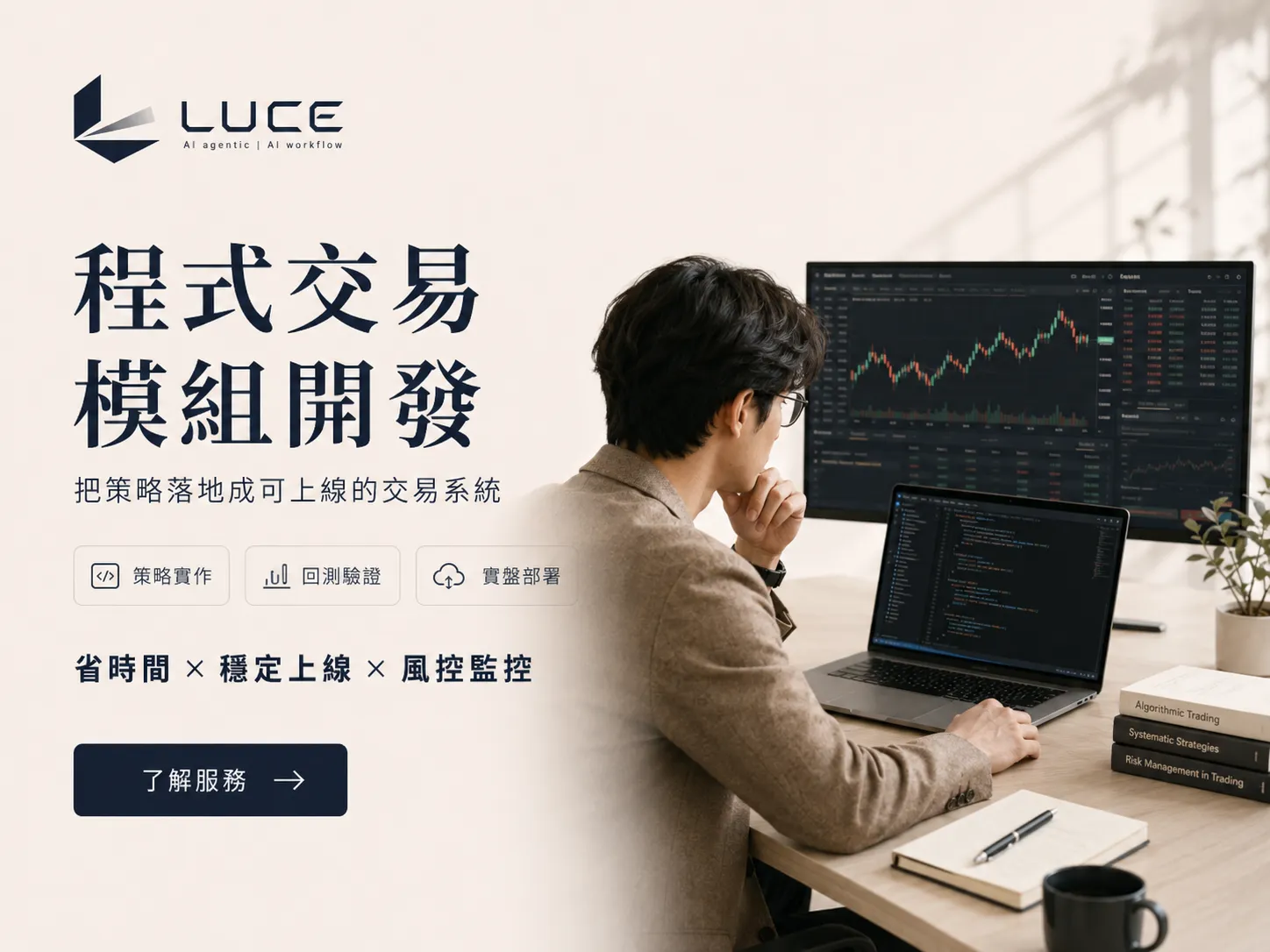

Algorithmic Trading Module Development
Ship strategies from manual to live
Algorithmic trading modules for individual traders, quant teams, brokers, and crypto exchanges — covering strategy implementation, backtest validation, live deployment, and risk monitoring.
Interested in Algorithmic Trading Module Development?
Drop your situation below. I'll reply within one business day with initial thoughts. Free, no hard sell.
- Automate manually-executed trading strategies
- Need batch backtesting + parameter optimization
- Multi-market / multi-instrument unified management and risk control
- Have quant logic but lack engineering execution
- Crypto exchange API integration (spot, futures, cross-exchange arbitrage)
- 01/ Strategy logic implementation (indicators, entry/exit, position sizing)
- 02/ Backtest system (transaction cost, slippage, Sharpe, max drawdown, profit factor)
- 03/ Broker / exchange API integration (Yuanta, SinoPac, BTSE, Binance, Bybit, etc.)
- 04/ Order management system (OMS): place, cancel, track, reconnection, retry
- 05/ Risk gateway (position limits, daily stop-loss, anomalous-order checks)
- 06/ Alerting (Telegram / LINE push, log archival, exception reporting)
- 07/ Complete handoff documentation (parameter tuning, operations SOP)
- Previously ran API and spot / futures realtime monitoring, incident response, and post-mortem at a major crypto exchange — I know every failure mode you'll hit in live markets
- Combined engineering depth with financial credentials (Trust Business Specialist, FinTech Knowledge Certification) — I can read your strategy AND ship stable code
- Phased delivery (PoC → backtest → paper trading → live) keeps your capital at risk on a managed timeline
Python (pandas, numpy, backtrader, ccxt), TypeScript / Node.js, PostgreSQL, Redis, Docker, GitHub Actions CI/CD
Scope-based (PoC / partial modules / full system)
30-min discovery call → scope and pricing → phased delivery → launch handoff
Why phased delivery isn’t just being cautious
Live markets surface every problem that backtests didn’t think about: liquidity gaps, API connection jitter, exchange-side throttling, slippage that explodes on large orders. I spent time running API and spot/derivatives realtime monitoring at a major crypto exchange — I’ve watched paper-perfect strategies blow up three days after going live, more than once.
So I default to a four-phase engagement:
Phase 1 · Strategy PoC — convert your logic into runnable code, validate against historical data, confirm the single-scenario behavior matches expectation.
Phase 2 · Full backtest — add transaction costs, slippage, limit-vs-market order differences. Produce Sharpe, max drawdown, profit factor reports. If the numbers don’t pass this layer, we stop here — saves your money.
Phase 3 · Paper trading — real broker/exchange API integration but orders go to simulated accounts. This layer catches API retry logic, reconnection handling, order state sync issues.
Phase 4 · Live — small position first with Telegram/LINE alerts, then scale gradually.
Each phase has a go/no-go decision point — you can stop at any time.
Brokers and exchanges I’ve integrated
Taiwan futures: Yuanta Futures, SinoPac Futures. Crypto spot + futures: Binance, Bybit, BTSE, OKX, Bitget. Others on request (Interactive Brokers, Alpaca, Kraken — depends on API documentation depth).
Risk control isn’t just “a few if statements”
Order Management Systems and risk gateways need to handle the boundary cases: system restarts, reconnection mid-order, end-of-day settlement, partial fills. A complete handoff includes parameter tuning guides and operations SOP so you (or your engineer) can take over independently.
Browse other services or email me
If this isn't the right fit, see the rest of the catalog — or skip the form and send a message directly.